
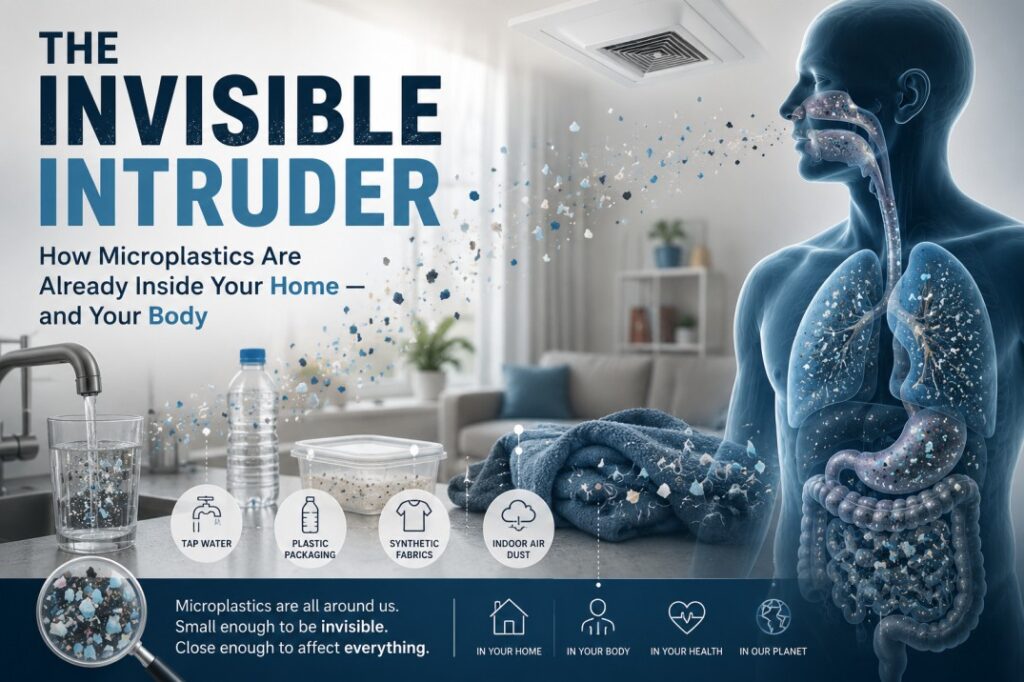
You vacuum the floors. You wash the dishes. You change the filters. And yet, without realizing it, your home is likely releasing and accumulating one of the most pervasive pollutants of our time: microplastics.
These are not the plastic bags drifting across a highway or the water bottle someone tossed on a hiking trail. Microplastics are particles smaller than 5 millimetres — many invisible to the naked eye — and they are everywhere. In the dust settling on your bookshelf. In the fleece hoodie hanging by the door. In the sea salt you sprinkle on dinner. In your own blood.
This is not a distant, abstract environmental problem. It is happening in your living room, right now.
Where Do Household Microplastics Come From?
The sources are surprisingly ordinary.
Synthetic fabrics are one of the biggest culprits in Canadian homes. Every time you run a load of laundry containing polyester, nylon, or acrylic clothing, hundreds of thousands of microscopic fibres are released into the washing water. Most wastewater treatment facilities are not designed to capture particles this small, so a significant portion flows through and eventually reaches rivers, lakes, and the St. Lawrence River. Estimates suggest a single wash cycle can release anywhere from 700,000 to over a million fibres, depending on the garment and washing conditions.
Plastic packaging degradation is another steady source. Single-use containers, foam trays, plastic wrap, and even reusable plastic containers begin to shed particles as they age, especially when exposed to heat, UV light, or friction. Microwaving food in plastic containers — something millions of Canadians do daily — can dramatically accelerate this breakdown, releasing microplastic particles and chemical additives directly into meals.
Indoor dust carries a surprising plastic load. Studies analyzing household dust have found it to contain microplastic fibres from synthetic carpets, upholstered furniture, plastic-coated walls, and the breakdown of everyday objects. We breathe this dust constantly, and children who spend more time close to the floor are particularly exposed.
Plastic water pipes and bottle breakdown add to the intake. Bottled water, despite its premium image, has been found to contain significantly higher microplastic concentrations than tap water in many cities. Drinking 1.5 litres of bottled water per day could mean ingesting tens of thousands of microplastic particles annually from the container alone.
What Are They Doing Inside Us?
Research into the human health effects of microplastics is still developing, but findings so far are cause for serious concern.
Microplastic particles have been detected in human blood, lung tissue, liver, kidney, and stool samples. A 2022 study published in the journal Environment International found microplastics in the bloodstream of 77% of participants tested — marking the first evidence of ongoing, widespread human internal contamination at the population level.
More recently, studies have found microplastics in the placentas of newborns, meaning that exposure begins before birth. Researchers have also detected them in breast milk, suggesting they can transfer from mother to child during early feeding.
The particles themselves are not the only concern. Plastics are manufactured with a range of chemical additives — flame retardants, plasticizers, UV stabilizers — many of which are known endocrine disruptors. When plastic particles enter the body, they can carry these chemicals along with them, potentially interfering with hormonal systems, immune responses, and cellular function over time.
Inflammation markers, oxidative stress, and disruptions to gut microbiome health have all been associated with microplastic exposure in laboratory and early human studies. While long-term causal effects in humans are still being studied, the precautionary signal is already clear: this is a substance we do not want accumulating in our bodies, and reducing exposure makes sense now, not after decades of further research.
Canada’s Unique Vulnerability
Canada faces a particular challenge when it comes to microplastic contamination, and it is tied directly to geography and weather.
With the world’s longest coastline, the country’s lakes, rivers, and marine ecosystems are vast collection points for plastic pollution blown in from urban areas, agricultural runoff, and storm drainage. The Great Lakes alone receive an estimated 10,000 tonnes of plastic annually from both the Canadian and American sides of the border. Lake Ontario, one of the most densely populated watersheds in the country, shows some of the highest microplastic concentrations measured in freshwater systems anywhere on Earth.
In Arctic regions, microplastics arrive not just from local sources but from atmospheric transport — they are carried by wind currents from industrial centres thousands of kilometres away and deposited in snow and ice. Studies of Arctic sea ice have found concentrations of microplastics that, when the ice melts, release a pulse of plastic particles into marine ecosystems during the warmer months.
Canadian seafood — mussels, oysters, salmon, arctic char — carries measurable microplastic contamination. For communities where fish is a dietary staple, particularly many Indigenous communities across the country, this represents both an environmental justice concern and a food security issue that disproportionately affects those who have contributed least to the problem.
What You Can Do at Home Today
Feeling overwhelmed is understandable. But the good news is that small, deliberate changes compound meaningfully over time — and several of the most effective steps are also among the most practical.
1. Add a microfibre filter to your washing machine. Devices like the Lint LUV-R or Cora Ball can be installed easily and capture a substantial portion of synthetic fibres before they enter the wastewater stream. Washing on a cold, short, gentle cycle also reduces fibre shedding compared to hot or high-agitation washes.
2. Switch away from synthetic fabrics where you can. Natural fibres — cotton, wool, linen, hemp, silk — do not shed plastic. When buying new clothing, prioritize these materials especially for high-wear, high-wash items like activewear and everyday basics. You do not need to throw away your existing wardrobe, but being intentional going forward makes a difference.
3. Stop microwaving in plastic. Transfer food to glass, ceramic, or stainless steel containers before heating. This is one of the simplest, lowest-cost swaps you can make, and it immediately removes a key pathway of plastic ingestion in your household.
4. Filter your tap water and ditch bottled water. A quality carbon-block or reverse osmosis filter can dramatically reduce microplastic concentrations in drinking water compared to both tap and bottled sources. This also saves money and eliminates a major source of single-use plastic from your home.
5. Choose natural flooring and furniture where possible. If you are renovating or replacing furniture, opting for wood, tile, wool carpet, or leather over synthetic carpet and upholstered foam can reduce the microplastic content of your indoor dust over time.
6. Reduce overall plastic in your home. Less plastic simply means fewer particles to shed. Swapping plastic food storage containers for glass or stainless steel, eliminating plastic wrap in favour of beeswax wrap or silicone lids, and buying loose produce rather than pre-packaged items all contribute to lowering your household’s plastic load.
The Bigger Picture: Individual Action Within a Systemic Problem
It bears saying clearly: the microplastic crisis is not primarily a consumer behaviour problem. It is a production problem. Billions of tonnes of plastic are manufactured every year, the majority of it designed for single use, the majority of it with no viable end-of-life pathway. The particles in your blood and your child’s placenta are the downstream result of choices made by corporations and enabled by insufficient regulation — not primarily the result of personal failure to recycle correctly.
That said, reducing your household exposure is not just about personal health. It normalizes the expectation that plastic-free and low-plastic options should be standard, it creates market demand that influences manufacturers, and it contributes to lower overall plastic pollution in the shared environments — watersheds, air, soil — that affect entire communities.
At Stop Plastic Canada, we believe that individual action and systemic change are not competing priorities. They are complementary. While you filter your laundry and swap your containers, we are pushing for stronger policy — mandatory microfibre filters on all new washing machines, extended producer responsibility that makes plastic manufacturers accountable for end-of-life costs, and binding reduction targets for single-use and hard-to-recycle plastics in Canada.
The microplastics are already here. But the choices we make now — in our homes and in our politics — will determine how much more accumulates in the decades ahead.
Want to take the next step? Sign our petition calling on the federal government to mandate microfibre filters on all new washing machines sold in Canada, and share this article with someone who needs to know.